
A few weeks ago, there was an article in the New York Times about simple tests to gauge if you’re aging well. Things like, can you get to the floor from standing then get back up hands free? Can you stand on one leg? What speed are you walking? The one that grabbed me – no pun intended – was the research showing that grip strength is a strongly related to longevity. In simple terms: the stronger your grip, the better your chances of aging well. Grip strength has been linked to lower risk of falls, better mobility, and even lower mortality rates. I knew it!
If you practice Pilates for longevity — as I do and as many of my clients do — this matters.
Pilates is meant to strengthen the whole body. That includes your hands.
Your grip muscles are some of your most primal muscles. You know how tiny babies grip onto your finger? It’s called the Palmar Grasp Reflex that’s found in human babies and primates.
It isn’t a learned action. These are primitive survival instincts, a phylogenetic/primitive motor pattern shared with other primates — not just a cute baby behavior.
They are literally survival muscles. From climbing, to carrying, to feeding yourself, the ability to grasp is fundamental to human function. Yet these grip muscles are some of the first to decline as we age. Lower grip strength is linked not just to weaker hands, but to accelerated biological aging, diminished functional capacity, and greater risk of disability and mortality later in life. In many ways it’s one of the earliest and most sensitive muscular markers of aging detectable decades before frailty sets in.
For some reason, in many Pilates studios, the hands are treated like decorative accessories instead of functional tools.
You’ve probably heard the cue:
“Keep your fingers long.”
“Don’t grip the handles.”
“Reach your fingers long in the handles.”
Why?
It looks pretty. It looks balletic.
But is it functional? No.
Try this experiment:
Can you pick up something heavy with long fingers?
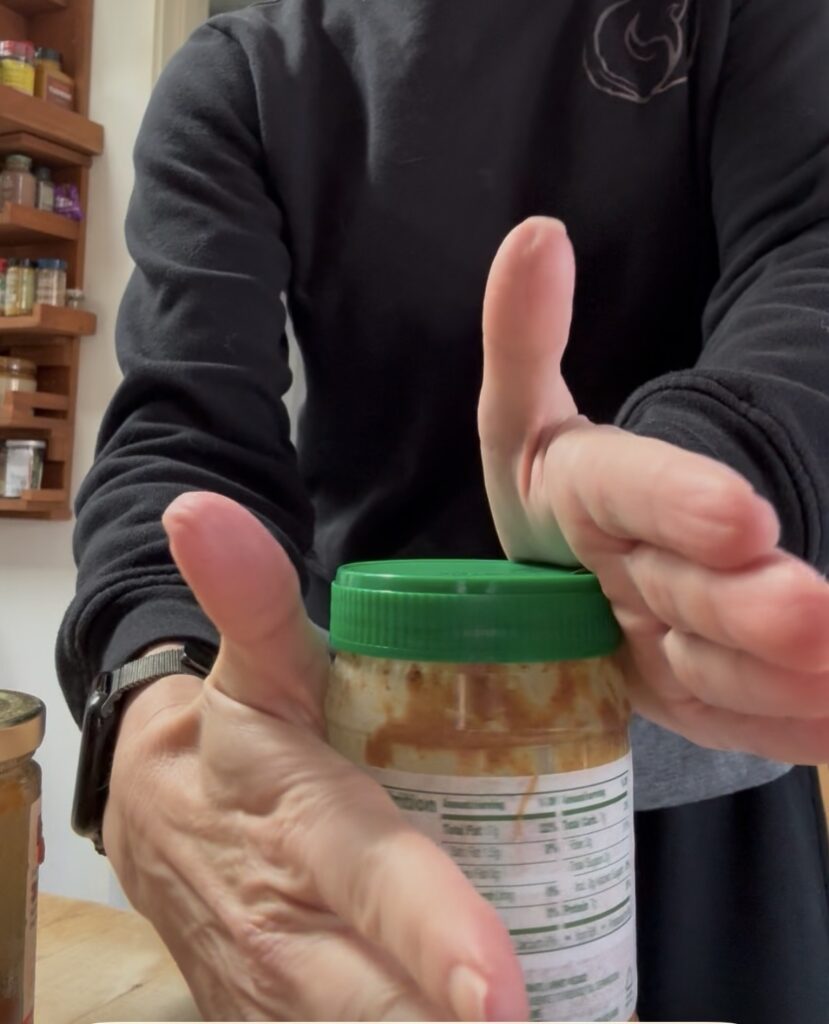
Can you open a stuck jar with long fingers?
Can you carry groceries with long fingers?
Of course not.
In real life, strength requires grasping.
As a classical Pilates teacher, if you look up archival photos of Joseph Pilates he is grasping the handles. I wish I could show the pictures here but unfortunately, most of them are trademarked. That’s a whole other story for another day.
Later on as the method evolved and many ballet dancers were teaching, the exercises became more aesthetic. I respect the method deeply — but I don’t believe in blind acceptance or blind following. My job is not to preserve cues that don’t make sense. My job is to help my clients reach their physical goals and stay as strong as possible as long as possible, so why would we leave the hands out of the equation?
My first teacher, Romana Kryzanowska taught an exercise called Castanets where you tap each finger to your thumb to improve finger mobility and coordination. It’s a great exercise — and it has value.
But mobility alone isn’t enough.
We can do more for our hands than just keep them flexible. We can make them strong, as Joseph Pilates intended.
Using the handles in Pilates allows us to train the hands the way they’re meant to work in real life: through grasping, loading, and connecting into the arms and shoulders. When you actually hold the straps instead of balancing them on long fingers, you’re not just moving your fingers — you’re strengthening the entire grip system: fingers, palm, forearm, up to your shoulders and neck.
In exercises like:
-
The Hundred
-
The Hug
-
Coordination
-
Pulling Straps
- Backstroke and Teaser
-
Arm Springs
…the handles are meant to be held firmly. Not draped across limp fingers, but grasped.
I often tell my clients:
“Use your hands the way they were designed.”
Some teachers argue that gripping the handles will “get into your neck and shoulders” or that it will “take the tension into your neck.” I’ve heard these cues for years and they just don’t make sense.
First, your neck and shoulders are supposed to be strong.
Second, using your hands appropriately does not create tension.
What it does create is connection.
When you grasp a handle properly, you engage the muscles of your forearm — the flexors and extensors that control your fingers and wrist. Those muscles connect into the muscles of the forearm and then to the upper arm — your biceps and triceps — which connect into the shoulder girdle and upper back, and yes, ultimately into the muscles that support your neck.
That’s not a problem.
That’s building real strength.
Strength is not about isolating tiny parts and pretending the rest of the body doesn’t exist. Strength is about integration. If we are truly trying to prepare people for real life — lifting, carrying, pulling, opening jars and bottles — then teaching them to avoid using their hands makes zero sense.
If we want Pilates to translate into daily living, we must train what daily living actually requires.
And daily living requires grip.
So the next time you’re holding the handles, ask:
Why am I keeping my fingers long?
Is it because it’s functional — or because it looks pretty? There are exceptions, of course, like in the exercise Shaving, you reach your fingers long in the handles because it’s an overhead exercise and you want to keep your wrists in the right alignment. Also, when you’re practicing on the mat and not holding onto anything, have at it – reach your fingers long. Yes! But when you’re holding a handle or a weight, wrap your fingers around it and grasp it. Your future body will thank you.
If Pilates is about longevity, then we must train for usefulness, not just elegance.
Strong hands support strong arms.
Strong arms support strong shoulders.
Strong shoulders support a strong neck and spine.
And a strong grip will lead to a longer life.
Come join a class at Phoenix Classical Pilates in Santa Monica to strengthen your whole body, fingers to toes!